All categories
Product Configuration_
Decision Checklist: 2D or 3D Product Configurator for eCommerce?
If you’re using 3D configurators for ecommerce, you could be spending more money than necessary and overcomplicating the buying journey. Discover when 2D configurators are a better option.


Product Configuration_
Decision Checklist: 2D or 3D Product Configurator for eCommerce?
If you’re using 3D configurators for ecommerce, you could be spending more money than necessary and overcomplicating the buying journey. Discover when 2D configurators are a better option.


Product Configuration_
Decision Checklist: 2D or 3D Product Configurator for eCommerce?
If you’re using 3D configurators for ecommerce, you could be spending more money than necessary and overcomplicating the buying journey. Discover when 2D configurators are a better option.

Product configurators are no longer a nice-to-have when you sell customizable products. Your customers need to compare options, understand pricing, or see exactly what they’re getting before they hit that buy button.
Choose the wrong type, and you’ll feel it fast. Load times can suffer, especially on mobile, and buyers may become overwhelmed or confused. Development and maintenance costs can also balloon as your catalog grows or changes.
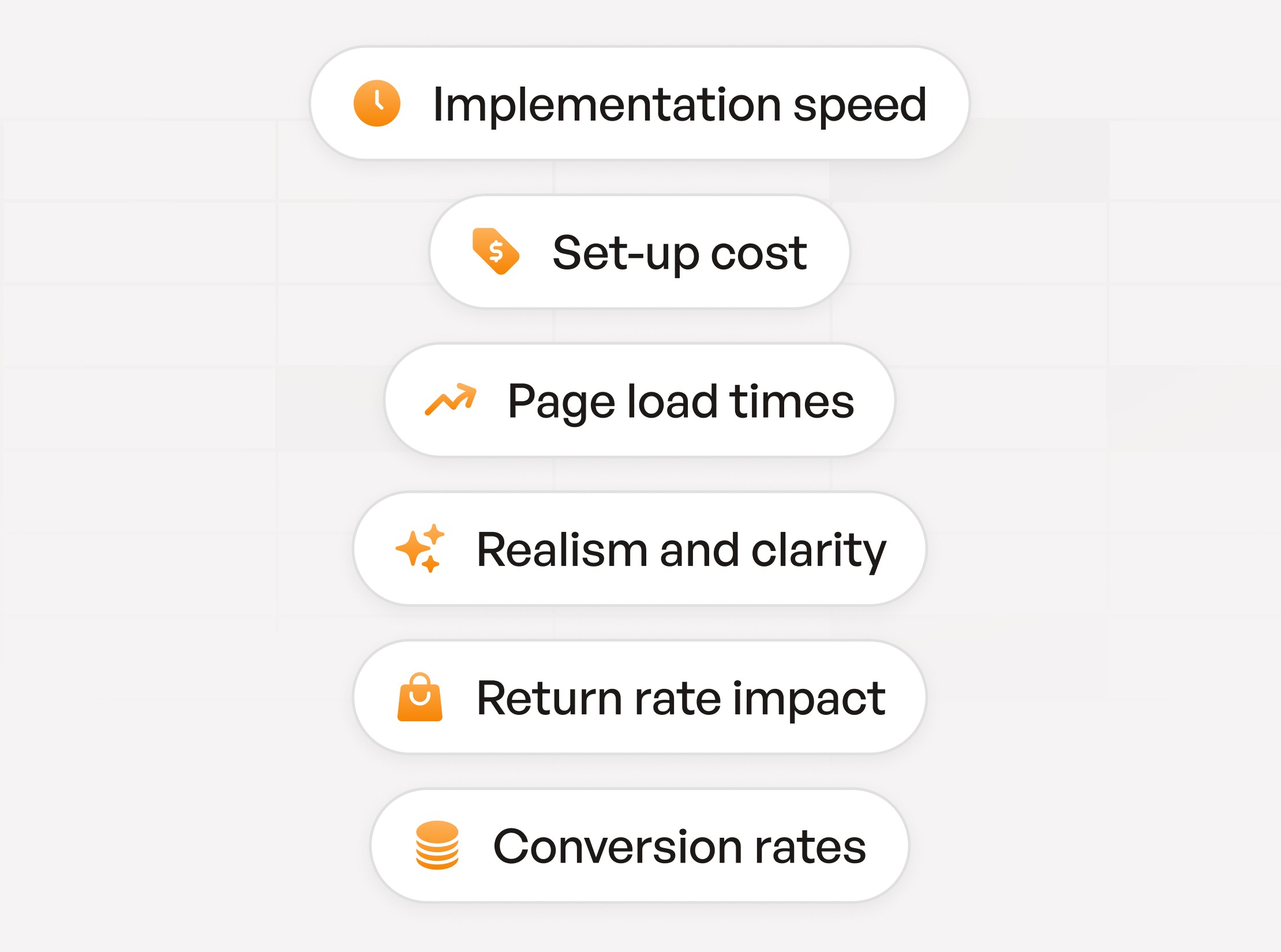
Run through this checklist when choosing between 2D and 3D configurators for ecommerce. We evaluate each option based on what matters: speed, clarity, scalability, and how well it helps customers make decisions.
Let’s dive in, shall we?
Key Takeaways
2D configurators excel when logic, pricing rules, speed, and scalability matter more than visual realism. They help customers reach decisions faster with less friction.
3D configurators are most effective when visual accuracy directly impacts confidence, conversions, or returns. They suit design-led, high-ticket products with fewer SKUs.
Performance, mobile experience, and maintenance costs are major decision points. Faster, lighter experiences generally outperform visually complex ones, especially on mobile.
2D configurators scale better across large or frequently changing catalogs. 3D tools suit focused, slower-moving product lines.
Outback Plunge Pools grew 50%+ year-on-year using logic-based configurators with 2D layered images and complex pricing automation.
What Do We Mean by 2D vs. 3D Product Configurators?
First, it helps to be clear on what people actually mean when they talk about 2D and 3D product configurators. The difference is more than visual, encompassing how customers interact with your product and how decisions get made.
2D Product Configurators
These focus on logic and usability. They use flat, interface-driven customization to guide buyers through choices step by step.
This typically includes dropdowns, buttons, color swatches, checkboxes, and conditional logic that shows or hides options based on earlier selections. Pricing updates in real time as customers configure the product, all without relying on heavy graphics or complex rendering.
3D Product Configurators
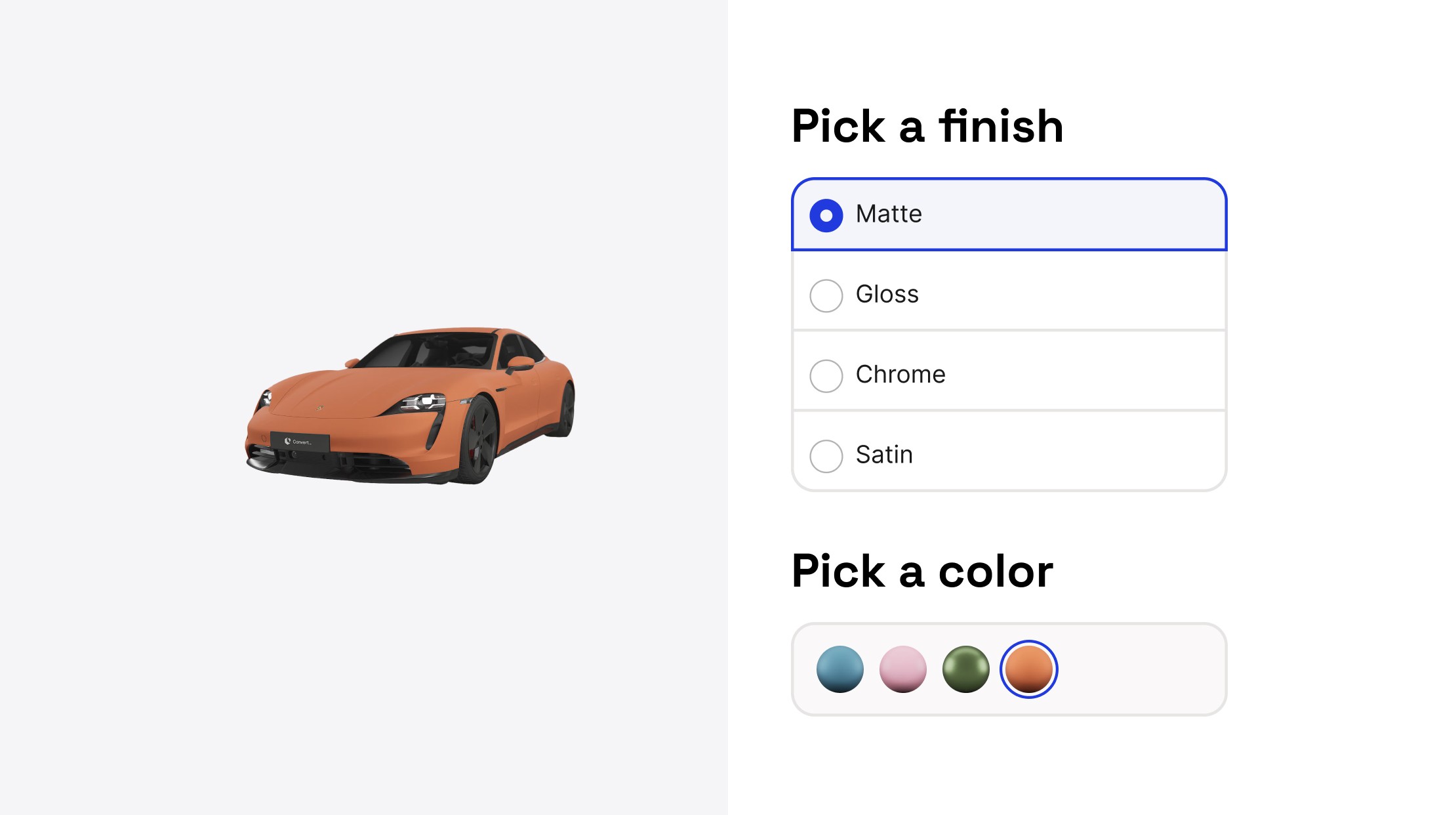
These are built around visual interaction. Customers can rotate, zoom, and explore a realistic 3D model of the product as they customize it.
These tools emphasize realism and spatial accuracy, which can be crucial when size, proportions, or physical fit influence buying decisions. They’re often paired with augmented reality or advanced visualization to help customers picture the product in a real-world context.
The Core Question: What Job Is the Configurator Doing?
Before comparing features or aesthetics, step back and ask what role the configurator is actually playing in the buying journey. A configurator isn’t there to impress. It’s there to help customers make a decision.
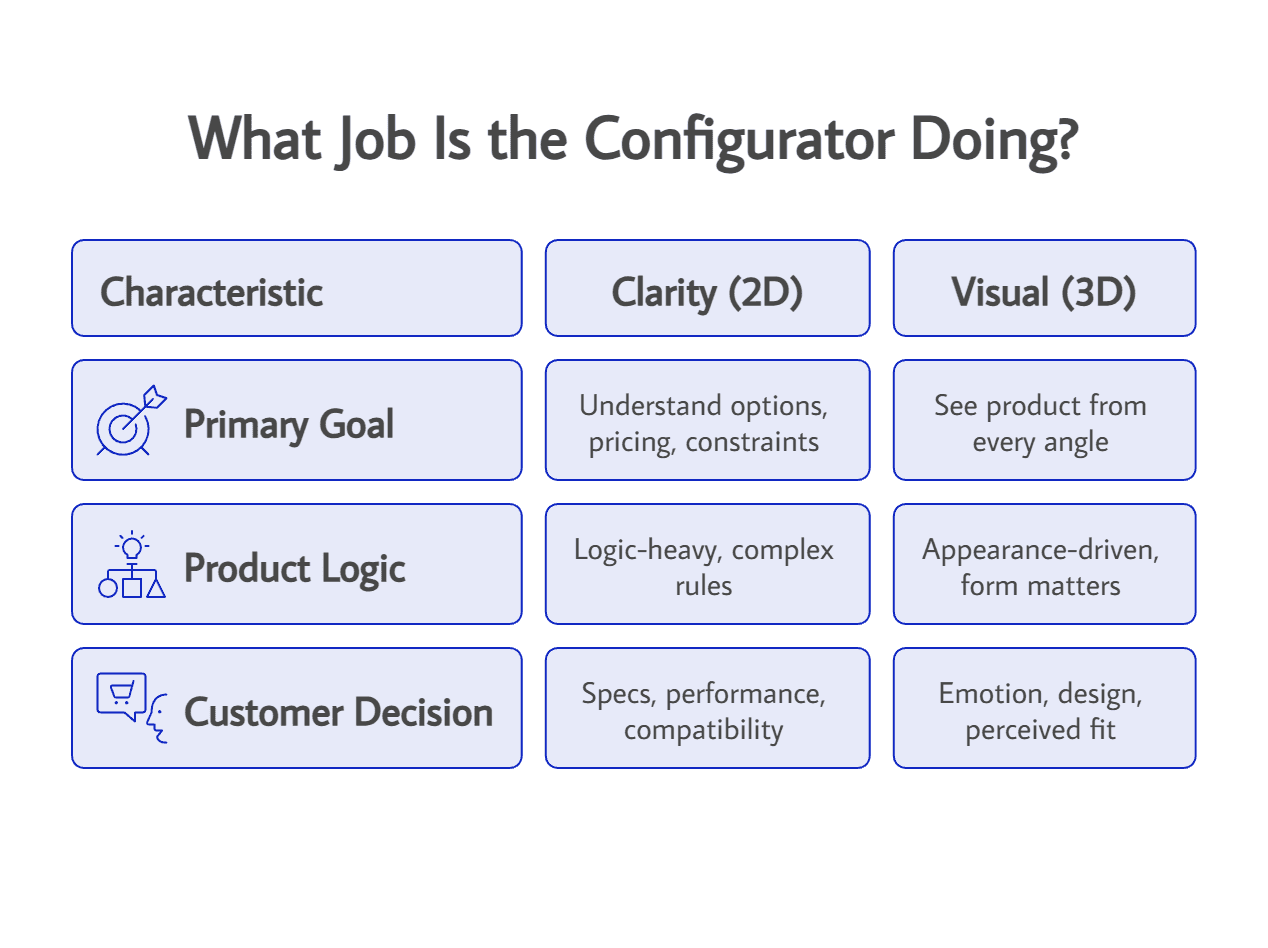
Here are 3 questions to ask:
Is the primary goal clarity or visual immersion?
Some buyers just want to understand options, pricing, and constraints quickly.
Others need to see the product from every angle before they feel confident moving forward.
Is the product logic-heavy or appearance-driven?
Products with complex rules, dependencies, or pricing formulas usually benefit from a logic-first 2D experience.
Products where form, color, or proportions matter more tend to lean more towards visual 3D experiences.
Are customers deciding from specs or looks?
If purchase decisions hinge on measurements, performance, or compatibility, 2D generally wins.
If emotion, design, or perceived fit drives confidence, visual 3D immersion does more of the work.
Once you’re clear on the job the configurator needs to do, the 2D vs 3D decision becomes far more obvious.
Decision Checklist for Choosing 2D or 3D Configurators
Running through the 7 factors in this checklist should help you choose between a 2D and 3D product configurator.
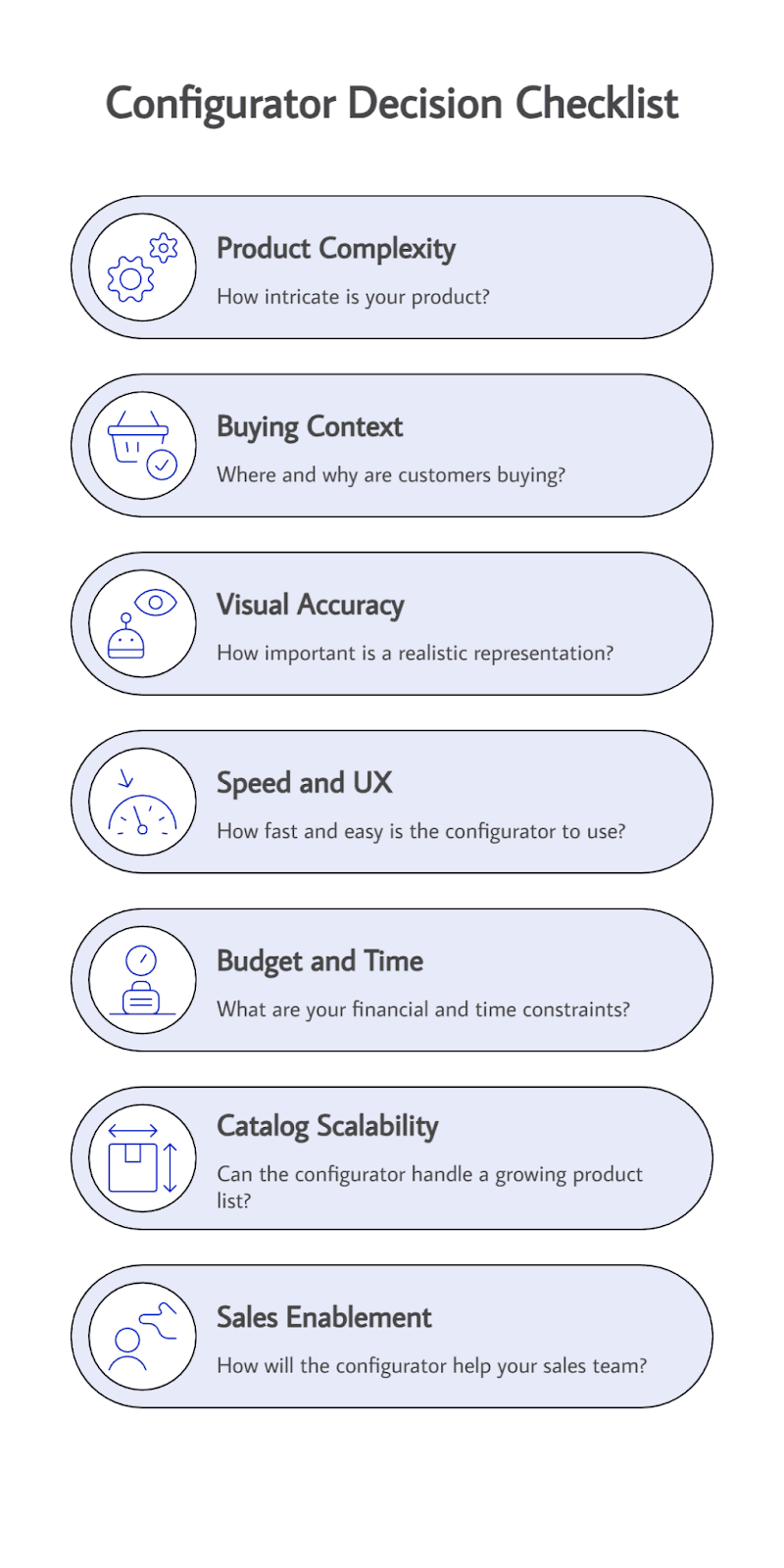
1. Product Complexity
Complexity shows up in different ways, and it has a direct impact on whether 2D or 3D configurators will serve you better.
Consider:
The number of options and dependencies customers can choose from. More options and rules typically mean a heavier logic layer behind the scenes.
Whether complexity comes from logical constraints or visual variations. Some products have complex pricing rules, compatibility, or exclusions. Others are simple logically, but change a lot visually, or fit within a broader aesthetic context.
Rule of thumb:
If logic matters more than visual immersion, lean 2D.
If form and fit drive confidence, consider 3D.
2. Buying Context and Customer Intent
How and why customers are buying matters just as much as what they’re buying. The same product can call for a very different configurator depending on intent and audience.
Quick quote vs. considered purchase: If buyers want to quickly configure, price, and quote with minimal friction, lean towards 2D. For longer, more considered purchases, visual 3D exploration can play a bigger role in building confidence.
B2B procurement vs. DTC browsing: B2B buyers are often comparing specs, budgets, and constraints under time pressure. DTC shoppers are more likely to explore, experiment, and respond to visual cues.
The clearer you are on intent and context, the easier it is to avoid underdelivering for customers or overbuilding your product configurator.
3. Need for Visual Accuracy
Some products can be sold on specs alone. Others fall apart if the visual expectation isn’t right. This is where visual accuracy becomes a deciding factor.
Does color, proportion, or spatial fit directly affect the purchase decision? If small visual differences change how the product is perceived or used, customers may need to see those details clearly before buying.
Are customers worried about what it will really look like once it arrives? If hesitation shows up in pre-sales questions or abandoned carts, that’s often a signal that visuals aren’t doing enough work.
Are returns driven by expectation gaps? When customers send products back because they didn’t look or fit the way they expected, a better representation can reduce that friction.
If visual confidence is a major blocker, 3D can earn its keep. If not, simpler 2D visual product configurators often get customers to a decision faster.
Embed pool product configurator
4. Speed, Performance, and UX
Speed is a major part of the user experience. It directly affects whether customers complete or abandon the configuration process.
Page load expectations: Shoppers expect configurators to load quickly and respond instantly. Slow initial loads or laggy interactions create friction before customers even engage.
Mobile performance constraints: Mobile devices have less processing power. Heavy assets, complex rendering, or long load times can disrupt the experience and make users bounce.
Drop-off risk during configuration: Every delay, stutter, or confusing interaction increases the chance someone quits halfway through. The longer the configurator takes to respond, the higher the risk of abandonment.
Simpler, faster experiences tend to win when speed and completion rate matter more than visual polish.
5. Budget and Time to Launch
Budget and timelines always need to be considered, even if the use case feels clear. Factor in the initial build and what it takes to maintain the configurator over time.
Upfront modeling and asset costs: 3D configurators typically require custom models, textures, and testing. That work adds cost and extends timelines compared to logic-driven 2D setups.
Ongoing updates when products change: Every new option, variation, or product update can mean revisiting assets, rules, or pricing. The more visual the experience, the heavier those updates tend to be.
Internal resources vs. external dev reliance: If your team can manage logic and pricing rules in-house, 2D is easier to own long term. 3D experiences typically rely more on specialized external developers or agencies.
No-code builders like Convert_ make building and maintaining 2D logic-driven product configurators much easier and cheaper. You can have a configurator ready to publish in an hour or two, without hiring expensive developers.
Embed chair product configurator
6. Scalability of Your Catalog
What works for a small product set can break quickly as your catalog grows.
One hero product vs. hundreds of SKUs: A single flagship product can justify a richer, more custom experience. Large catalogs usually benefit from repeatable, 2D rules-based configurations that don’t require custom work for every item.
Frequency of product updates: If options, pricing, or availability change often, you’ll want a system that’s easy to update without rebuilding assets or workflows each time.
Regional pricing, rules, or variations: Selling across regions often means different prices, constraints, or configurations. Logic-driven setups scale more smoothly when those rules need to change.
As your catalog grows and evolves, you need a configurator that won’t slow you down later.
7. Sales Enablement and Lead Qualification
A configurator doesn’t just support the buying experience. It can also play a direct role in how leads are qualified and handed off to sales.
Do you need instant pricing or instant visuals? Some sales processes rely on fast, accurate pricing to move deals forward. Others benefit more from helping prospects visualize the final product before a conversation starts.
Is the configurator feeding quotes, a CRM, or sales teams? When configuration data flows into quotes or sales systems, accuracy and structure matter. Clean inputs make follow-ups faster and more effective.
Are you qualifying buyers or just inspiring them? If the goal is to identify serious buyers and reduce wasted sales time, logic and constraints do a lot of heavy lifting. If the goal is early-stage interest, visual inspiration may be enough.
The clearer the sales outcome you want, the easier it is to choose the configurator that supports it.
When is a 2D Product Configurator the Smarter Choice?
A 2D product configurator is often the better option when clarity, speed, and control matter more than visual realism.
It’s usually the smarter choice if you’re dealing with:
Complex pricing logic or rules-based products
Large or frequently changing catalogs
B2B, industrial, or services-adjacent eCommerce
Faster deployment with lower ongoing cost
If your priority is helping customers reach a decision quickly, 2D often delivers the strongest return on investment.
When Does a 3D Product Configurator Make Sense?
A 3D product configurator earns its place when seeing the product is a core part of the decision, not a nice extra.
It makes the most sense if you’re selling:
High-ticket, design-led products
Products with strong emotional or aesthetic buying triggers
Fewer SKUs with longer product lifecycles
Products where visual confidence directly impacts conversion or returns
In these cases, the visualization a 3D product configurator delivers removes doubt when it matters most. This outweighs the higher costs and launch times.
Common Mistakes Companies Make
Even well-intentioned teams sometimes get the choice between 2D and 3D product configurators for ecommerce wrong. These are some common mistakes.
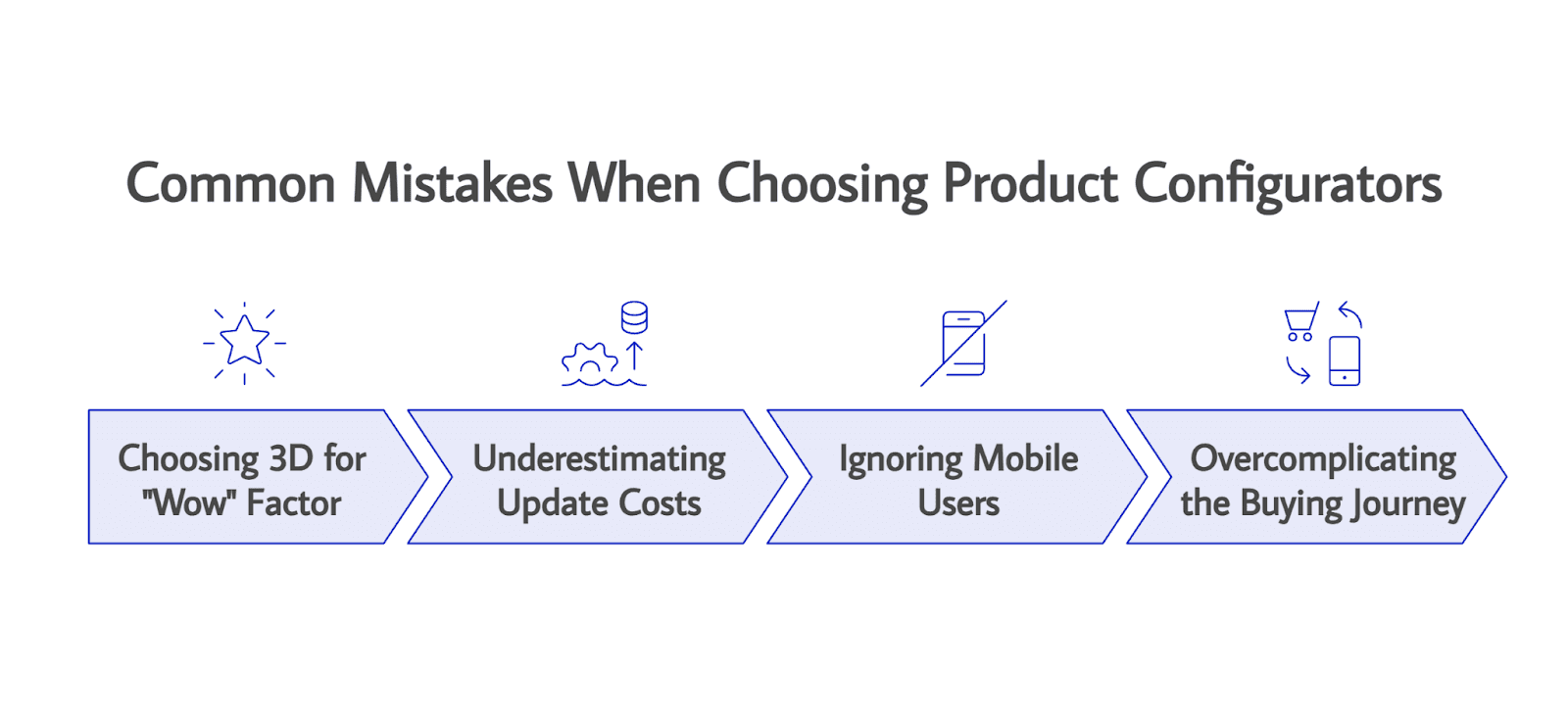
Choosing 3D for “wow” instead of utility
A visually impressive configurator doesn’t help if it slows users down or distracts from the decision. If it doesn’t make buying easier, it’s working against you.
Underestimating maintenance and update costs
Every product change, option update, or pricing tweak has a cost. Visual-heavy setups tend to compound that effort over time.
Ignoring mobile users
What works smoothly on desktop can fall apart on mobile. Heavy assets, small controls, or slow load times push mobile users to quickly abandon configurators.
Overcomplicating the buying journey
More options and interactions aren’t always better. When configuration feels like work, customers can give up.
Avoiding these mistakes usually has more impact on conversion than choosing the “most advanced” technology.
Final Decision Summary
The right configurator is the one that supports how customers decide, not the one that looks the most impressive.
Choose a 2D configurator if you need:
Speed, clarity, and scalability across your catalog
Support for complex pricing or option logic
Faster ROI with easier, lower-effort maintenance
Choose a 3D configurator if you need:
Visual trust and realism to remove doubt
Strong emotional engagement during the buying process
Higher confidence before purchase, especially for considered or high-ticket products
Align the configurator to the decision it’s meant to support, and the right answer usually becomes obvious.
Product configurators are no longer a nice-to-have when you sell customizable products. Your customers need to compare options, understand pricing, or see exactly what they’re getting before they hit that buy button.
Choose the wrong type, and you’ll feel it fast. Load times can suffer, especially on mobile, and buyers may become overwhelmed or confused. Development and maintenance costs can also balloon as your catalog grows or changes.
Run through this checklist when choosing between 2D and 3D configurators for ecommerce. We evaluate each option based on what matters: speed, clarity, scalability, and how well it helps customers make decisions.
Let’s dive in, shall we?
Key Takeaways
2D configurators excel when logic, pricing rules, speed, and scalability matter more than visual realism. They help customers reach decisions faster with less friction.
3D configurators are most effective when visual accuracy directly impacts confidence, conversions, or returns. They suit design-led, high-ticket products with fewer SKUs.
Performance, mobile experience, and maintenance costs are major decision points. Faster, lighter experiences generally outperform visually complex ones, especially on mobile.
2D configurators scale better across large or frequently changing catalogs. 3D tools suit focused, slower-moving product lines.
Outback Plunge Pools grew 50%+ year-on-year using logic-based configurators with 2D layered images and complex pricing automation.
What Do We Mean by 2D vs. 3D Product Configurators?
First, it helps to be clear on what people actually mean when they talk about 2D and 3D product configurators. The difference is more than visual, encompassing how customers interact with your product and how decisions get made.
2D Product Configurators
These focus on logic and usability. They use flat, interface-driven customization to guide buyers through choices step by step.
This typically includes dropdowns, buttons, color swatches, checkboxes, and conditional logic that shows or hides options based on earlier selections. Pricing updates in real time as customers configure the product, all without relying on heavy graphics or complex rendering.
3D Product Configurators
These are built around visual interaction. Customers can rotate, zoom, and explore a realistic 3D model of the product as they customize it.
These tools emphasize realism and spatial accuracy, which can be crucial when size, proportions, or physical fit influence buying decisions. They’re often paired with augmented reality or advanced visualization to help customers picture the product in a real-world context.
The Core Question: What Job Is the Configurator Doing?
Before comparing features or aesthetics, step back and ask what role the configurator is actually playing in the buying journey. A configurator isn’t there to impress. It’s there to help customers make a decision.

Here are 3 questions to ask:
Is the primary goal clarity or visual immersion?
Some buyers just want to understand options, pricing, and constraints quickly.
Others need to see the product from every angle before they feel confident moving forward.
Is the product logic-heavy or appearance-driven?
Products with complex rules, dependencies, or pricing formulas usually benefit from a logic-first 2D experience.
Products where form, color, or proportions matter more tend to lean more towards visual 3D experiences.
Are customers deciding from specs or looks?
If purchase decisions hinge on measurements, performance, or compatibility, 2D generally wins.
If emotion, design, or perceived fit drives confidence, visual 3D immersion does more of the work.
Once you’re clear on the job the configurator needs to do, the 2D vs 3D decision becomes far more obvious.
Decision Checklist for Choosing 2D or 3D Configurators
Running through the 7 factors in this checklist should help you choose between a 2D and 3D product configurator.

1. Product Complexity
Complexity shows up in different ways, and it has a direct impact on whether 2D or 3D configurators will serve you better.
Consider:
The number of options and dependencies customers can choose from. More options and rules typically mean a heavier logic layer behind the scenes.
Whether complexity comes from logical constraints or visual variations. Some products have complex pricing rules, compatibility, or exclusions. Others are simple logically, but change a lot visually, or fit within a broader aesthetic context.
Rule of thumb:
If logic matters more than visual immersion, lean 2D.
If form and fit drive confidence, consider 3D.
2. Buying Context and Customer Intent
How and why customers are buying matters just as much as what they’re buying. The same product can call for a very different configurator depending on intent and audience.
Quick quote vs. considered purchase: If buyers want to quickly configure, price, and quote with minimal friction, lean towards 2D. For longer, more considered purchases, visual 3D exploration can play a bigger role in building confidence.
B2B procurement vs. DTC browsing: B2B buyers are often comparing specs, budgets, and constraints under time pressure. DTC shoppers are more likely to explore, experiment, and respond to visual cues.
The clearer you are on intent and context, the easier it is to avoid underdelivering for customers or overbuilding your product configurator.
3. Need for Visual Accuracy
Some products can be sold on specs alone. Others fall apart if the visual expectation isn’t right. This is where visual accuracy becomes a deciding factor.
Does color, proportion, or spatial fit directly affect the purchase decision? If small visual differences change how the product is perceived or used, customers may need to see those details clearly before buying.
Are customers worried about what it will really look like once it arrives? If hesitation shows up in pre-sales questions or abandoned carts, that’s often a signal that visuals aren’t doing enough work.
Are returns driven by expectation gaps? When customers send products back because they didn’t look or fit the way they expected, a better representation can reduce that friction.
If visual confidence is a major blocker, 3D can earn its keep. If not, simpler 2D visual product configurators often get customers to a decision faster.
Embed pool product configurator
4. Speed, Performance, and UX
Speed is a major part of the user experience. It directly affects whether customers complete or abandon the configuration process.
Page load expectations: Shoppers expect configurators to load quickly and respond instantly. Slow initial loads or laggy interactions create friction before customers even engage.
Mobile performance constraints: Mobile devices have less processing power. Heavy assets, complex rendering, or long load times can disrupt the experience and make users bounce.
Drop-off risk during configuration: Every delay, stutter, or confusing interaction increases the chance someone quits halfway through. The longer the configurator takes to respond, the higher the risk of abandonment.
Simpler, faster experiences tend to win when speed and completion rate matter more than visual polish.
5. Budget and Time to Launch
Budget and timelines always need to be considered, even if the use case feels clear. Factor in the initial build and what it takes to maintain the configurator over time.
Upfront modeling and asset costs: 3D configurators typically require custom models, textures, and testing. That work adds cost and extends timelines compared to logic-driven 2D setups.
Ongoing updates when products change: Every new option, variation, or product update can mean revisiting assets, rules, or pricing. The more visual the experience, the heavier those updates tend to be.
Internal resources vs. external dev reliance: If your team can manage logic and pricing rules in-house, 2D is easier to own long term. 3D experiences typically rely more on specialized external developers or agencies.
No-code builders like Convert_ make building and maintaining 2D logic-driven product configurators much easier and cheaper. You can have a configurator ready to publish in an hour or two, without hiring expensive developers.
Embed chair product configurator
6. Scalability of Your Catalog
What works for a small product set can break quickly as your catalog grows.
One hero product vs. hundreds of SKUs: A single flagship product can justify a richer, more custom experience. Large catalogs usually benefit from repeatable, 2D rules-based configurations that don’t require custom work for every item.
Frequency of product updates: If options, pricing, or availability change often, you’ll want a system that’s easy to update without rebuilding assets or workflows each time.
Regional pricing, rules, or variations: Selling across regions often means different prices, constraints, or configurations. Logic-driven setups scale more smoothly when those rules need to change.
As your catalog grows and evolves, you need a configurator that won’t slow you down later.
7. Sales Enablement and Lead Qualification
A configurator doesn’t just support the buying experience. It can also play a direct role in how leads are qualified and handed off to sales.
Do you need instant pricing or instant visuals? Some sales processes rely on fast, accurate pricing to move deals forward. Others benefit more from helping prospects visualize the final product before a conversation starts.
Is the configurator feeding quotes, a CRM, or sales teams? When configuration data flows into quotes or sales systems, accuracy and structure matter. Clean inputs make follow-ups faster and more effective.
Are you qualifying buyers or just inspiring them? If the goal is to identify serious buyers and reduce wasted sales time, logic and constraints do a lot of heavy lifting. If the goal is early-stage interest, visual inspiration may be enough.
The clearer the sales outcome you want, the easier it is to choose the configurator that supports it.
When is a 2D Product Configurator the Smarter Choice?
A 2D product configurator is often the better option when clarity, speed, and control matter more than visual realism.
It’s usually the smarter choice if you’re dealing with:
Complex pricing logic or rules-based products
Large or frequently changing catalogs
B2B, industrial, or services-adjacent eCommerce
Faster deployment with lower ongoing cost
If your priority is helping customers reach a decision quickly, 2D often delivers the strongest return on investment.
When Does a 3D Product Configurator Make Sense?
A 3D product configurator earns its place when seeing the product is a core part of the decision, not a nice extra.
It makes the most sense if you’re selling:
High-ticket, design-led products
Products with strong emotional or aesthetic buying triggers
Fewer SKUs with longer product lifecycles
Products where visual confidence directly impacts conversion or returns
In these cases, the visualization a 3D product configurator delivers removes doubt when it matters most. This outweighs the higher costs and launch times.
Common Mistakes Companies Make
Even well-intentioned teams sometimes get the choice between 2D and 3D product configurators for ecommerce wrong. These are some common mistakes.

Choosing 3D for “wow” instead of utility
A visually impressive configurator doesn’t help if it slows users down or distracts from the decision. If it doesn’t make buying easier, it’s working against you.
Underestimating maintenance and update costs
Every product change, option update, or pricing tweak has a cost. Visual-heavy setups tend to compound that effort over time.
Ignoring mobile users
What works smoothly on desktop can fall apart on mobile. Heavy assets, small controls, or slow load times push mobile users to quickly abandon configurators.
Overcomplicating the buying journey
More options and interactions aren’t always better. When configuration feels like work, customers can give up.
Avoiding these mistakes usually has more impact on conversion than choosing the “most advanced” technology.
Final Decision Summary
The right configurator is the one that supports how customers decide, not the one that looks the most impressive.
Choose a 2D configurator if you need:
Speed, clarity, and scalability across your catalog
Support for complex pricing or option logic
Faster ROI with easier, lower-effort maintenance
Choose a 3D configurator if you need:
Visual trust and realism to remove doubt
Strong emotional engagement during the buying process
Higher confidence before purchase, especially for considered or high-ticket products
Align the configurator to the decision it’s meant to support, and the right answer usually becomes obvious.
Product configurators are no longer a nice-to-have when you sell customizable products. Your customers need to compare options, understand pricing, or see exactly what they’re getting before they hit that buy button.
Choose the wrong type, and you’ll feel it fast. Load times can suffer, especially on mobile, and buyers may become overwhelmed or confused. Development and maintenance costs can also balloon as your catalog grows or changes.
Run through this checklist when choosing between 2D and 3D configurators for ecommerce. We evaluate each option based on what matters: speed, clarity, scalability, and how well it helps customers make decisions.
Let’s dive in, shall we?
Key Takeaways
2D configurators excel when logic, pricing rules, speed, and scalability matter more than visual realism. They help customers reach decisions faster with less friction.
3D configurators are most effective when visual accuracy directly impacts confidence, conversions, or returns. They suit design-led, high-ticket products with fewer SKUs.
Performance, mobile experience, and maintenance costs are major decision points. Faster, lighter experiences generally outperform visually complex ones, especially on mobile.
2D configurators scale better across large or frequently changing catalogs. 3D tools suit focused, slower-moving product lines.
Outback Plunge Pools grew 50%+ year-on-year using logic-based configurators with 2D layered images and complex pricing automation.
What Do We Mean by 2D vs. 3D Product Configurators?
First, it helps to be clear on what people actually mean when they talk about 2D and 3D product configurators. The difference is more than visual, encompassing how customers interact with your product and how decisions get made.
2D Product Configurators
These focus on logic and usability. They use flat, interface-driven customization to guide buyers through choices step by step.
This typically includes dropdowns, buttons, color swatches, checkboxes, and conditional logic that shows or hides options based on earlier selections. Pricing updates in real time as customers configure the product, all without relying on heavy graphics or complex rendering.
3D Product Configurators
These are built around visual interaction. Customers can rotate, zoom, and explore a realistic 3D model of the product as they customize it.
These tools emphasize realism and spatial accuracy, which can be crucial when size, proportions, or physical fit influence buying decisions. They’re often paired with augmented reality or advanced visualization to help customers picture the product in a real-world context.
The Core Question: What Job Is the Configurator Doing?
Before comparing features or aesthetics, step back and ask what role the configurator is actually playing in the buying journey. A configurator isn’t there to impress. It’s there to help customers make a decision.

Here are 3 questions to ask:
Is the primary goal clarity or visual immersion?
Some buyers just want to understand options, pricing, and constraints quickly.
Others need to see the product from every angle before they feel confident moving forward.
Is the product logic-heavy or appearance-driven?
Products with complex rules, dependencies, or pricing formulas usually benefit from a logic-first 2D experience.
Products where form, color, or proportions matter more tend to lean more towards visual 3D experiences.
Are customers deciding from specs or looks?
If purchase decisions hinge on measurements, performance, or compatibility, 2D generally wins.
If emotion, design, or perceived fit drives confidence, visual 3D immersion does more of the work.
Once you’re clear on the job the configurator needs to do, the 2D vs 3D decision becomes far more obvious.
Decision Checklist for Choosing 2D or 3D Configurators
Running through the 7 factors in this checklist should help you choose between a 2D and 3D product configurator.

1. Product Complexity
Complexity shows up in different ways, and it has a direct impact on whether 2D or 3D configurators will serve you better.
Consider:
The number of options and dependencies customers can choose from. More options and rules typically mean a heavier logic layer behind the scenes.
Whether complexity comes from logical constraints or visual variations. Some products have complex pricing rules, compatibility, or exclusions. Others are simple logically, but change a lot visually, or fit within a broader aesthetic context.
Rule of thumb:
If logic matters more than visual immersion, lean 2D.
If form and fit drive confidence, consider 3D.
2. Buying Context and Customer Intent
How and why customers are buying matters just as much as what they’re buying. The same product can call for a very different configurator depending on intent and audience.
Quick quote vs. considered purchase: If buyers want to quickly configure, price, and quote with minimal friction, lean towards 2D. For longer, more considered purchases, visual 3D exploration can play a bigger role in building confidence.
B2B procurement vs. DTC browsing: B2B buyers are often comparing specs, budgets, and constraints under time pressure. DTC shoppers are more likely to explore, experiment, and respond to visual cues.
The clearer you are on intent and context, the easier it is to avoid underdelivering for customers or overbuilding your product configurator.
3. Need for Visual Accuracy
Some products can be sold on specs alone. Others fall apart if the visual expectation isn’t right. This is where visual accuracy becomes a deciding factor.
Does color, proportion, or spatial fit directly affect the purchase decision? If small visual differences change how the product is perceived or used, customers may need to see those details clearly before buying.
Are customers worried about what it will really look like once it arrives? If hesitation shows up in pre-sales questions or abandoned carts, that’s often a signal that visuals aren’t doing enough work.
Are returns driven by expectation gaps? When customers send products back because they didn’t look or fit the way they expected, a better representation can reduce that friction.
If visual confidence is a major blocker, 3D can earn its keep. If not, simpler 2D visual product configurators often get customers to a decision faster.
Embed pool product configurator
4. Speed, Performance, and UX
Speed is a major part of the user experience. It directly affects whether customers complete or abandon the configuration process.
Page load expectations: Shoppers expect configurators to load quickly and respond instantly. Slow initial loads or laggy interactions create friction before customers even engage.
Mobile performance constraints: Mobile devices have less processing power. Heavy assets, complex rendering, or long load times can disrupt the experience and make users bounce.
Drop-off risk during configuration: Every delay, stutter, or confusing interaction increases the chance someone quits halfway through. The longer the configurator takes to respond, the higher the risk of abandonment.
Simpler, faster experiences tend to win when speed and completion rate matter more than visual polish.
5. Budget and Time to Launch
Budget and timelines always need to be considered, even if the use case feels clear. Factor in the initial build and what it takes to maintain the configurator over time.
Upfront modeling and asset costs: 3D configurators typically require custom models, textures, and testing. That work adds cost and extends timelines compared to logic-driven 2D setups.
Ongoing updates when products change: Every new option, variation, or product update can mean revisiting assets, rules, or pricing. The more visual the experience, the heavier those updates tend to be.
Internal resources vs. external dev reliance: If your team can manage logic and pricing rules in-house, 2D is easier to own long term. 3D experiences typically rely more on specialized external developers or agencies.
No-code builders like Convert_ make building and maintaining 2D logic-driven product configurators much easier and cheaper. You can have a configurator ready to publish in an hour or two, without hiring expensive developers.
Embed chair product configurator
6. Scalability of Your Catalog
What works for a small product set can break quickly as your catalog grows.
One hero product vs. hundreds of SKUs: A single flagship product can justify a richer, more custom experience. Large catalogs usually benefit from repeatable, 2D rules-based configurations that don’t require custom work for every item.
Frequency of product updates: If options, pricing, or availability change often, you’ll want a system that’s easy to update without rebuilding assets or workflows each time.
Regional pricing, rules, or variations: Selling across regions often means different prices, constraints, or configurations. Logic-driven setups scale more smoothly when those rules need to change.
As your catalog grows and evolves, you need a configurator that won’t slow you down later.
7. Sales Enablement and Lead Qualification
A configurator doesn’t just support the buying experience. It can also play a direct role in how leads are qualified and handed off to sales.
Do you need instant pricing or instant visuals? Some sales processes rely on fast, accurate pricing to move deals forward. Others benefit more from helping prospects visualize the final product before a conversation starts.
Is the configurator feeding quotes, a CRM, or sales teams? When configuration data flows into quotes or sales systems, accuracy and structure matter. Clean inputs make follow-ups faster and more effective.
Are you qualifying buyers or just inspiring them? If the goal is to identify serious buyers and reduce wasted sales time, logic and constraints do a lot of heavy lifting. If the goal is early-stage interest, visual inspiration may be enough.
The clearer the sales outcome you want, the easier it is to choose the configurator that supports it.
When is a 2D Product Configurator the Smarter Choice?
A 2D product configurator is often the better option when clarity, speed, and control matter more than visual realism.
It’s usually the smarter choice if you’re dealing with:
Complex pricing logic or rules-based products
Large or frequently changing catalogs
B2B, industrial, or services-adjacent eCommerce
Faster deployment with lower ongoing cost
If your priority is helping customers reach a decision quickly, 2D often delivers the strongest return on investment.
When Does a 3D Product Configurator Make Sense?
A 3D product configurator earns its place when seeing the product is a core part of the decision, not a nice extra.
It makes the most sense if you’re selling:
High-ticket, design-led products
Products with strong emotional or aesthetic buying triggers
Fewer SKUs with longer product lifecycles
Products where visual confidence directly impacts conversion or returns
In these cases, the visualization a 3D product configurator delivers removes doubt when it matters most. This outweighs the higher costs and launch times.
Common Mistakes Companies Make
Even well-intentioned teams sometimes get the choice between 2D and 3D product configurators for ecommerce wrong. These are some common mistakes.

Choosing 3D for “wow” instead of utility
A visually impressive configurator doesn’t help if it slows users down or distracts from the decision. If it doesn’t make buying easier, it’s working against you.
Underestimating maintenance and update costs
Every product change, option update, or pricing tweak has a cost. Visual-heavy setups tend to compound that effort over time.
Ignoring mobile users
What works smoothly on desktop can fall apart on mobile. Heavy assets, small controls, or slow load times push mobile users to quickly abandon configurators.
Overcomplicating the buying journey
More options and interactions aren’t always better. When configuration feels like work, customers can give up.
Avoiding these mistakes usually has more impact on conversion than choosing the “most advanced” technology.
Final Decision Summary
The right configurator is the one that supports how customers decide, not the one that looks the most impressive.
Choose a 2D configurator if you need:
Speed, clarity, and scalability across your catalog
Support for complex pricing or option logic
Faster ROI with easier, lower-effort maintenance
Choose a 3D configurator if you need:
Visual trust and realism to remove doubt
Strong emotional engagement during the buying process
Higher confidence before purchase, especially for considered or high-ticket products
Align the configurator to the decision it’s meant to support, and the right answer usually becomes obvious.
FAQ
Read our answers to frequently asked questions below.
What’s the main difference between a 2D and a 3D product configurator?
A 2D configurator focuses on logic, options, and pricing. It uses interface elements like dropdowns and rules. A 3D configurator focuses on visual realism, letting customers rotate and explore the product as they customize it.
What’s the main difference between a 2D and a 3D product configurator?
A 2D configurator focuses on logic, options, and pricing. It uses interface elements like dropdowns and rules. A 3D configurator focuses on visual realism, letting customers rotate and explore the product as they customize it.
What’s the main difference between a 2D and a 3D product configurator?
A 2D configurator focuses on logic, options, and pricing. It uses interface elements like dropdowns and rules. A 3D configurator focuses on visual realism, letting customers rotate and explore the product as they customize it.
Is a 3D configurator always better for conversions?
No. 3D works best when visual confidence impacts the buying decision. If customers care more about specs, pricing, or speed, a 2D configurator often converts better.
Is a 3D configurator always better for conversions?
No. 3D works best when visual confidence impacts the buying decision. If customers care more about specs, pricing, or speed, a 2D configurator often converts better.
Is a 3D configurator always better for conversions?
No. 3D works best when visual confidence impacts the buying decision. If customers care more about specs, pricing, or speed, a 2D configurator often converts better.
Which configurator works best for B2B eCommerce?
In most cases, 2D. B2B buyers generally prioritize accuracy, pricing logic, and fast quotes over visual immersion.
Which configurator works best for B2B eCommerce?
In most cases, 2D. B2B buyers generally prioritize accuracy, pricing logic, and fast quotes over visual immersion.
Which configurator works best for B2B eCommerce?
In most cases, 2D. B2B buyers generally prioritize accuracy, pricing logic, and fast quotes over visual immersion.
How does mobile traffic affect the 2D vs. 3D decision?
Mobile users are less tolerant of slow load times and heavy experiences. If a large portion of your traffic is mobile, a lightweight 2D configurator is often the safer choice.
How does mobile traffic affect the 2D vs. 3D decision?
Mobile users are less tolerant of slow load times and heavy experiences. If a large portion of your traffic is mobile, a lightweight 2D configurator is often the safer choice.
How does mobile traffic affect the 2D vs. 3D decision?
Mobile users are less tolerant of slow load times and heavy experiences. If a large portion of your traffic is mobile, a lightweight 2D configurator is often the safer choice.
How do you know if your current configurator is holding you back?
Signs include high drop-off during configuration, frequent pre-sales questions about pricing or options, slow load times, or returns caused by mismatched expectations. If the configurator creates friction instead of confidence, it’s likely time to rethink the approach.
How do you know if your current configurator is holding you back?
Signs include high drop-off during configuration, frequent pre-sales questions about pricing or options, slow load times, or returns caused by mismatched expectations. If the configurator creates friction instead of confidence, it’s likely time to rethink the approach.
How do you know if your current configurator is holding you back?
Signs include high drop-off during configuration, frequent pre-sales questions about pricing or options, slow load times, or returns caused by mismatched expectations. If the configurator creates friction instead of confidence, it’s likely time to rethink the approach.
Continue reading
More leads in less time_
Stop wasting time on manual quotes. Automate your lead funnel today.
Create powerful on brand calculators, lead generation forms and apps that automate your marketing and sales processes
Start with a template
Find inspiration or customize an outstanding template, complete with functional formulas and flows to help you get started.
Let us build for you
We can build your calculator, and afterwards you can always make changes yourself. Our service starts at just $250.
More leads in less time_
Stop wasting time on manual quotes. Automate your lead funnel today.
Create powerful on brand calculators, lead generation forms and apps that automate your marketing and sales processes
Start with a template
Find inspiration or customize an outstanding template, complete with functional formulas and flows to help you get started.
Let us build for you
We can build your calculator, and afterwards you can always make changes yourself. Our service starts at just $250.


